
Junk Removal Weight-Based Pricing Guide for 2026

Last Updated: November 19, 2026
Quick Summary
Weight-based junk removal pricing charges you for the net weight of your load, calculated as the loaded truck's gross weight minus the empty truck's tare weight on a certified scale. You pay only for the verified tonnage your items add, so ask to see all three numbers on the scale ticket.
Volume-based pricing charges by truck space, while weight-based pricing charges by verified tonnage.
A 15-cubic-yard truck body holds roughly 10 to 12 cubic yards of loose household junk.
Apply a range of minus 20 percent to plus 30 percent to your weight estimate.
Drywall is dense and heavy, while lumber is bulky but lighter per piece.
Get the quote in writing and ask for the scale ticket at completion.
Tired of junk removal quotes that change at pickup?
Junk Outlawz quotes upfront, hauls same-day, and recycles what it can.
Table of Contents
How Junk Removal Weight-Based Pricing Actually Works
Weight-based pricing is the fairest model in junk removal: you pay for what your load actually weighs, verified on a certified scale rather than guessed by eye.
That difference has a name. Net weight is the gross weight of the loaded truck minus the tare weight of the empty truck.

The Three Numbers on Every Scale Ticket
Every certified scale ticket shows three figures. Gross weight is the loaded truck. Tare weight is the empty truck, recorded before the crew arrives at your property. Net weight is gross minus tare.
Ask to see all three. Ask to see the ticket. If a company quotes a flat price and never mentions a scale, you are paying for an estimate, not a measurement.
Junk Removal Volume vs Weight Pricing: Which Model You're Really Paying
The two pricing models produce very different bills, and most homeowners do not know which one they signed up for. Volume-based pricing charges by how much space your junk fills in the truck, usually expressed in fractions: quarter load, half load, full load. Weight-based pricing charges by the tonnage your items actually add.
Here is how they diverge in practice.
Factor | Volume-Based Pricing | Weight-Based Pricing |
What you pay for | Space in the truck | Verified tonnage |
Best for | Bulky, light items | Dense, heavy debris |
Verification | Crew's visual estimate | Certified scale ticket |
Risk of overpaying | High on light loads | Low, you see the number |
Common in | National franchises | Independent haulers |
Volume pricing is not automatically unfair. For a load of old couches and mattresses, space is the real constraint, and a volume quote can be accurate. The trouble starts with mixed loads.
If you are weighing a full cleanout against a rented container, our breakdown of junk removal vs dumpster rental cost compares both models by load size, labor, and fees.
Factors Affecting Junk Removal Costs Beyond the Scale
Weight is the headline number, but it is rarely the whole invoice. Several costs sit outside the scale, and knowing them keeps a quote from drifting upward on pickup day.
Labor, Crew Size and Loading Time
A single-item pickup needs one or two crew members. A full property cleanout may need three or four, plus hours of loading. Labor is priced into most quotes as a built-in component rather than a line item, which is why two companies can quote the same weight at different totals. Ask how many crew members will arrive and roughly how long the job should take.
Truck, Fuel, Travel and Disposal Fees
Every job carries transport overhead: the truck itself, fuel, drive time to your address, and the trip to the transfer station or landfill. Disposal fees are what the facility charges per ton, and they vary by location and material. Appliances with refrigerants, tires, and mattresses often carry separate handling charges because facilities process them differently. None of these are hidden if you ask upfront. Our guide to avoiding hidden fees in junk removal includes a written quote checklist and the exact questions to ask before booking.
How to Estimate Junk Removal Weight Before Pickup
You can get a useful weight estimate before anyone arrives, and it will help you sanity-check any quote you receive. The goal is not precision, it is catching a quote that is off by hundreds of pounds. A room-by-room inventory plus a material-density reference can give a rough estimate that is useful for flagging a bad quote.
Step 1: Build a Room-by-Room Inventory
Walk each room and list every item you want removed. Note the item type, approximate size, and material. Do not skip the awkward items, a cast-iron tub, a piano, or a loaded file cabinet can outweigh a whole bedroom of clothing and cardboard. Group the list by material category at the end: furniture, appliances, electronics, yard waste, construction debris, and general household clutter.
Step 2: Assign Weights Using Common Benchmarks
Use these typical ranges for household items. They are estimates, not guarantees.
Item | Typical Weight Range |
Sofa (two- or three-seat) | 90-150 lb |
Mattress and box spring (queen) | 80-140 lb |
Refrigerator | 200-300 lb |
Washer or dryer | 150-250 lb |
Upright piano | 300-500 lb |
Cast-iron bathtub | 300-500 lb |
Loaded file cabinet | 100-200 lb |
Bagged household clutter (per 30-gallon bag) | 20-40 lb |
For items not on the list, estimate by volume and material. A cubic foot of household clutter averages roughly 5 to 10 pounds; a cubic foot of dense debris such as tile or concrete runs far higher. When in doubt, round up, an overestimate protects you from a surprise invoice, while an underestimate makes a high quote look reasonable.
Step 3: Convert Volume to Weight for Bulky Loads
If you are estimating a full truckload rather than individual items, use volume as a cross-check. A 15-cubic-yard dump truck body holds roughly 10 to 12 cubic yards of loose household junk once loaded.
Watch out: volume-to-weight conversions vary widely by how tightly the crew packs the truck, so treat any single density figure as a range, not a fixed number.
Step 4: Total the Estimate and Set an Uncertainty Range
Add your item weights to get a ballpark net weight, then apply a range of roughly minus 20 percent to plus 30 percent. If your total lands at 1,000 pounds, plan for a realistic range of about 800 to 1,300 pounds. That range is what you compare against the quote.
Step 5: Compare the Estimate Against the Quote
Ask the hauler whether the quote is a flat rate or an estimate subject to weight, and what tonnage the estimate assumes. If your rough total says half a ton and the quote assumes two, ask why. A legitimate operator can explain the assumption, for example, that the quote includes a minimum charge or a full-truck allowance, and will confirm the final bill against the scale ticket.
A Worked Example
Suppose you are clearing a garage: one sofa (120 lb), a refrigerator (250 lb), a washer (180 lb), 15 bags of clutter at 30 lb each (450 lb), and a stack of lumber you estimate at 200 lb. The total is about 1,200 lb, or 0.6 ton. With the uncertainty range applied, plan for roughly 960 to 1,560 lb. If a quote assumes a full ton and a half, ask what else is being counted, and confirm whether the minimum charge, not the weight, is driving the number.
Material-Specific Weights: Drywall, Lumber and Heavy Debris
Material type changes the math more than most people expect. A truckload of household furniture and a truckload of renovation debris can occupy identical space and differ by a ton or more on the scale. The reason is density: the weight of a material per cubic foot determines how fast a load adds up, and facilities often price construction debris differently from household waste.
Density Benchmarks by Material
Use these ranges to compare loads. They reflect loose, un-compacted debris as typically loaded by a crew.
Material | Approximate Density (lb per cubic yard) | Handling Notes |
Drywall | 500-800 | Dense and heavy in chunks; breaks into dust and small pieces |
Lumber and framing | 200-400 | Bulky but lighter per piece; fills space quickly |
Concrete, brick, tile | 2,000-3,000+ | Heaviest common debris; often requires separate handling |
Carpet and padding | 150-300 | Light but bulky; rolls compact well |
Yard waste and branches | 300-500 | Light when dry, much heavier when green or wet |
Mixed household clutter | 150-300 | Varies widely with furniture and appliance content |
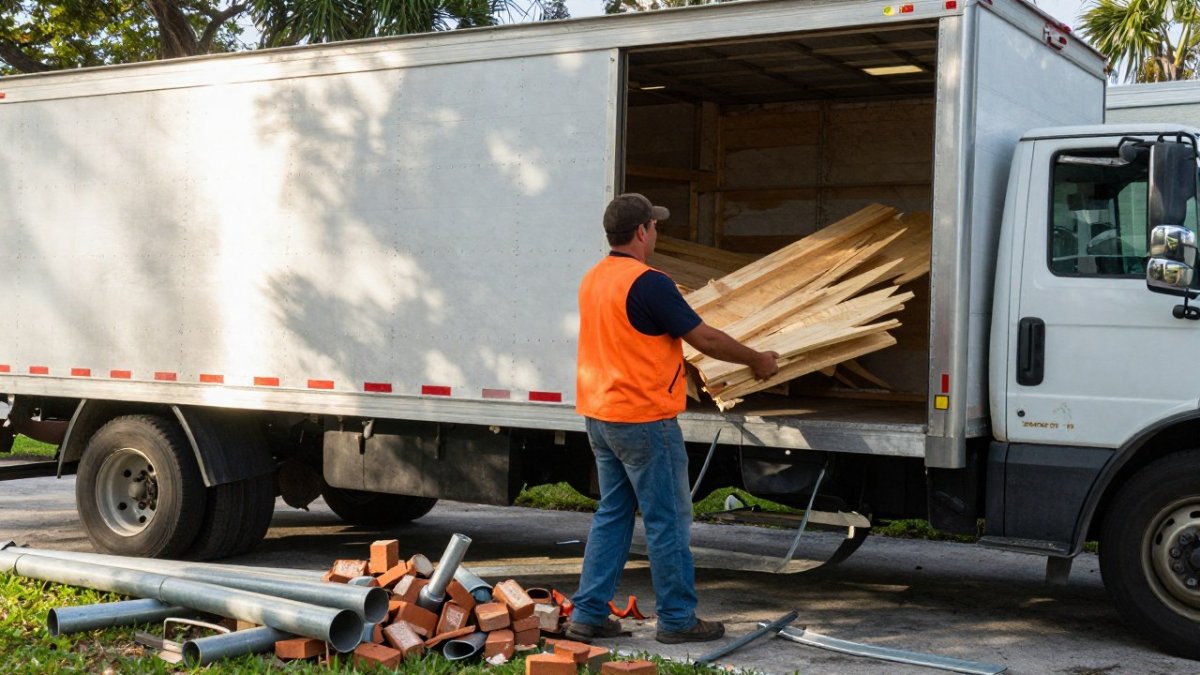
Drywall is the classic example. It is dense, breaks into heavy chunks, and adds up fast during a remodel, a small bathroom tear-out can produce several hundred pounds of drywall alone. Lumber is lighter per piece but bulky, so it fills space quickly and can make a load look larger than its weight suggests.
How Contamination and Mixed Loads Affect Billable Weight
Mixed loads complicate things further. When a load contains both household junk and construction debris, the facility may charge by the heaviest material category present, or may reject the load if it contains items the facility does not accept.
Watch out: a load that looks light can be reclassified at the scale if the facility identifies a denser material category, so ask the hauler how mixed loads are categorized before the truck leaves your property.
Why Material Rules Vary by Facility
Local disposal rules and fee variability matter more than broad regional averages suggest. Facility acceptance rules, per-ton tipping fees, and material-specific surcharges are set locally, and they change accepted loads and fees from one transfer station to the next. A material accepted at one facility may be banned at another a few miles away.
If you are clearing a renovation site, our guide to construction debris removal in Florida covers material-specific costs and removal options in detail.
Minimum Charges, Scale Tickets and Billing Disputes
Many haulers set a minimum charge for small jobs. Ask about any minimum before you book.
The most common billing dispute is simple: the final invoice does not match the quote. Protect yourself with three habits. Get the quote in writing, including whether it is a flat rate or an estimate subject to weight.
If you are only clearing a few items, read up on the minimum load size for junk removal so you know how small loads are measured and what the minimum charge actually covers.
Get an Upfront Weight-Based Quote from Junk Outlawz
A fair quote is one you can verify. If you want a quote that holds up on pickup day, our guide on how to get junk removal quotes that hold up walks through exactly what to ask.
Weight-based pricing only works when the hauler is willing to show you the numbers. Ask for the tare weight, the gross weight, and the scale ticket, and walk away from anyone who will not provide them.
Frequently Asked Questions
Is junk removal usually charged by weight or volume?
Most full-service junk removal companies quote by volume, pricing your load as a fraction of the truck (quarter, half, full). Weight-based pricing charges you for the actual tonnage hauled, verified on a scale ticket. Volume pricing is faster to quote on site; weight-based pricing is more transparent for dense loads like concrete, tile or drywall. Ask which model a company uses before you book, because the same pile can produce very different invoices under each.
What factors affect junk removal costs besides the weight of the load?
Labor and crew size, loading time, travel distance, fuel, truck capacity, disposal and landfill fees, and whether items need special handling all move the final number. Heavy materials like construction debris usually carry higher disposal fees than household clutter, and items such as mattresses or appliances may add handling charges. Stairs, long carries and tight access also add time, which shows up in the quote. Get an upfront written estimate that lists these separately.
How can I estimate junk removal weight before the crew arrives?
Start by listing your items by category and grouping them into light, medium and heavy. Dense debris like drywall or tile weighs far more than household clutter of the same volume. Photograph the pile from a few angles and share it when you request a quote.
What should I do if the final bill doesn't match the scale ticket?
Ask for the scale ticket before you pay. It should show gross weight (truck plus load), tare weight (empty truck) and net weight, which is the difference you are billed on. Compare the net weight to the estimate you were given and ask for an explanation of any gap. If a charge appears that was not in the written quote, raise it before paying.


Comments